You can now find the latest information about DC Audubon events and conservation news at http://www.dcaudubon.org/blog.
Please join us there and change your bookmarks.
-John
Thursday, March 22, 2007


Thursday, October 05, 2006
Talk about Birds in DC
Join DC Audubon and other Capitol city birders at Riverby's Books!
DC Audubon is co-hosting a talk on birds in the DC area. Peter Vankevich, DC Audubon member and author of a monthly DC birding column in the Hill Rag, and others will discuss what birds you may see in DC and tips on how to identify them. Reception to follow.
Riverby's Books
417 East Capitol St., SE
Oct. 19 @ 7 PM
DC Audubon is co-hosting a talk on birds in the DC area. Peter Vankevich, DC Audubon member and author of a monthly DC birding column in the Hill Rag, and others will discuss what birds you may see in DC and tips on how to identify them. Reception to follow.
Riverby's Books
417 East Capitol St., SE
Oct. 19 @ 7 PM
Tuesday, September 12, 2006
New Species: Bugun Liocichla
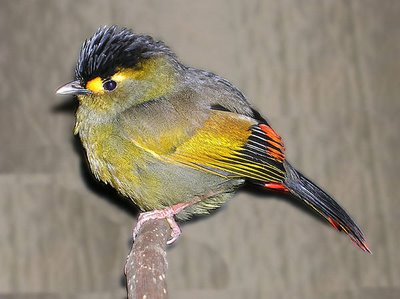
A beautiful new species has been discovered in India. The new species is a liocichla, related to babblers. An astronomer first saw the species in 1995 but could not identify it with existing field guides. He did not see it again for another decade. A colleague suggested that it was an Emei Shan Liocichla (Liocichla omeiensis), a species that occurs 1,000 km away in southwest China. In May 2006, he caught one bird. Measurements taken from that bird, as well as differences in plumage and calls, indicated that this liocichla was a separate species. It has been designated Bugun Liocichla (Liocichla bugunorum) after the local Bugun tribe that owns the forest where most sightings were made.

Friday, September 08, 2006
Upcoming Field Trip to Rock Creek Park
DC Audubon field trip announcement: mark your calendars.
Next Sunday, Sept. 17, join DC Audubon's annual field trip to Rock Creek Park in search of Fall migrants. We'll be looking for those confusing Fall warblers, of course, but not neglecting any others. Meet by the Rock Creek Nature Center at 7 A.M. (5200 Glover Rd., N.W., about 1/4 mile south of the intersection of Glover and Military Roads). The Ridge and Maintenance Yard areas will get most of our attention, but we may visit others (within walking distance from the Center) at the leader's discretion. We should finish up by 11. Besides the trusty binocs & field guide, I recommend insect repellant, sunscreen, and waterproof footwear (not a bad idea to bring water & snacks as well).
Please RSVP to the leader, Paul DeAnna by telephone in the evenings after 6pm (202) 544-2680. Please include a phone number where you can be reached the evening before the trip, just in case a weather postponement becomes necessary. If you can offer a ride to a non-driving birder in your neighborhood, please let me know the general area you're coming from. I'll do what I can to put those offering rides in touch with those needing them. Detailed driving directions are available on the Park's website.
Rock Creek is also accessible by public transportation. Take the E2 bus to the intersection of Miltary Road and Glover Road (a.k.a. Oregon Ave), NW. From there follow the path at the southeast corner of the intersection to the Nature Center.
An announcement of this field trip is also posted on our website.
Next Sunday, Sept. 17, join DC Audubon's annual field trip to Rock Creek Park in search of Fall migrants. We'll be looking for those confusing Fall warblers, of course, but not neglecting any others. Meet by the Rock Creek Nature Center at 7 A.M. (5200 Glover Rd., N.W., about 1/4 mile south of the intersection of Glover and Military Roads). The Ridge and Maintenance Yard areas will get most of our attention, but we may visit others (within walking distance from the Center) at the leader's discretion. We should finish up by 11. Besides the trusty binocs & field guide, I recommend insect repellant, sunscreen, and waterproof footwear (not a bad idea to bring water & snacks as well).
Please RSVP to the leader, Paul DeAnna by telephone in the evenings after 6pm (202) 544-2680. Please include a phone number where you can be reached the evening before the trip, just in case a weather postponement becomes necessary. If you can offer a ride to a non-driving birder in your neighborhood, please let me know the general area you're coming from. I'll do what I can to put those offering rides in touch with those needing them. Detailed driving directions are available on the Park's website.
Rock Creek is also accessible by public transportation. Take the E2 bus to the intersection of Miltary Road and Glover Road (a.k.a. Oregon Ave), NW. From there follow the path at the southeast corner of the intersection to the Nature Center.
An announcement of this field trip is also posted on our website.
Thursday, September 07, 2006
A Swift Night Out
If you know the location of a chimney swift roost, consider participating in A Swift Night Out. This project was begun to increase public awareness of chimney swifts and to support their conservation. There are two weekend counts this summer, one in August (already passed) and one this weekend. Here are the directions:
Chimney swifts became common in urban areas because of the availability of chimneys and other vertical structures for nesting. However, in recent years the population has declined as chimney construction has changed to discourage nesting. Swifts benefit city residents by consuming large number of insects every day. For more information on chimney swifts, see ChimneySwifts.org.
Here is how it works: Keep your eyes to the skies at dusk in late July and watch for areas where swifts are feeding. Look for a tall shaft, chimney or similar structure to locate where Chimney Swifts (central to east coast) or Vaux's Swift (Pacific coast) go to roost in your area.See here for contact information and results from previous years.
This year, on one night over the weekend of August 11, 12, 13, and / or September 8, 9, 10 observe the roost starting about 30 minutes before dusk and estimate the number of swifts that enter. When you have your number, contact us with your results. That's all there is to it!
Please include the following information:
- Number of swifts counted
- Time (and time zone)
- Date
- Location
- Address: city, state/province
- Broad description of the site, e.g. school, warehouse, residence, Chimney Swift Tower, etc.
- Weather conditions may also be reported.
Chimney swifts became common in urban areas because of the availability of chimneys and other vertical structures for nesting. However, in recent years the population has declined as chimney construction has changed to discourage nesting. Swifts benefit city residents by consuming large number of insects every day. For more information on chimney swifts, see ChimneySwifts.org.
Wednesday, August 30, 2006
Bald Eagle in Baltimore
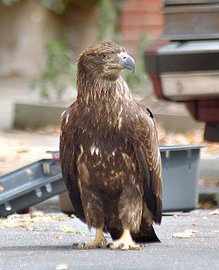 An immature bald eagle caused a stir in Baltimore today by landing on a city sidewalk in a residential neighorhood. It walked around on the sidewalk and the street for an hour and a half. Residents assumed that something was wrong with it and had called the Maryland Department of Natural Resources to send a wildlife rescuer. But before this could be arranged, the eagle flew away.
The Sun article provides two possible explanations from local wildlife experts. One focused on a possible injury.
"Why the heck it would stand around on Bolton Street for an hour? Who knows?" said Glenn Therres, associate director of the Wildlife and Heritage Service at the Maryland Department of Natural Resources. "I don't know if it flew into something and was dazed for a while. It could have been injured, but the fact that it flew away suggests the injury might not have been that severe."A second explanation is that it was merely resting.
At any given time, there are about 2,000 bald eagles in Maryland, Therres said. The eagles nest along the shores of tidal waters in the region, but the birds - which were upgraded to threatened from endangered in recent years - rarely if ever hang out on city sidewalks, Therres said.
"There are a lot of them floating around, acting like teenagers and juveniles, just kind of looking for a good place to eat or to socialize with other birds their own age," Therres said. "A wooded shoreline on the Potomac or Susquehanna [rivers], but not normally in an urban neighborhood in Baltimore City."
David Curson, director of bird conservation for the Maryland and District of Columbia branch of the National Audubon Society, said the bird might have eaten a large catch of fish and was too stuffed and lazy to move.
"It's difficult to explain, but one possibility is, it may have eaten a large meal," Curson said. "Sometimes, when a bird like that eats a large meal like that it gets weighed down. But without knowing all the facts and not having seen the bird myself, it's difficult to be sure."
Monday, August 28, 2006
Katrina Updates
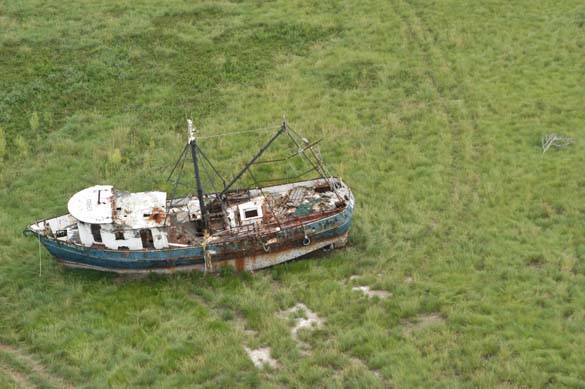 Now that we have arrived at the one-year anniversary of Hurricane Katrina's landfall on the Gulf Coast, newspaper articles are considering the lingering damage done by the storm. Many refuges along the coast were hard-hit and are struggling to recover. Part of the problem is that the storm washed salt water into fresh water ecosystems and killed vegetation that could not stand the salinity. The waters also dumped all forms of trash and toxic waste into the refuges. Cleaning and restoring the marshes will take years and substantial investment.
The refuges damaged along the coast are important for both breeding and migratory birds. Twelve Important Bird Areas lay in the direct path of the storm. The long-term effects of the storm on the birds that used those areas will not be known until more research is done. In the short term, many birds seem to have abandoned their traditional nesting habitats. Among the species with reduced nesting colonies include Brown Pelicans, several species of herons, Black Skimmers, and Sandhill Cranes.
On a lighter note, Judith Toups reports that in the weeks after Hurricane Katrina, her yard was filled with ruby-throated hummingbirds.
Monday, August 21, 2006
Bachman's Warbler?
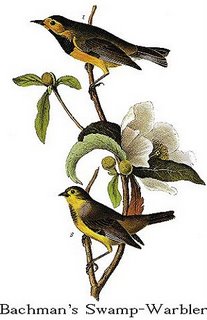
The Cornell Lab of Ornithology has posted video of a possible Bachman's Warbler on its website. This film was shot in Cuba in January 2002. After recording the bird, the photographer used field guides to identify it as a female Bachman's Warbler. Cornell's ornithologists reviewed the video and deemed it inconclusive. They have asked for comments from experienced observers.
What do you think of the video?
For comparison, here is a painting of male and female Bachman's Warblers by John James Audubon.
Sunday, August 20, 2006
New Rules For Canada Goose Management
The U.S. Fish and Wildlife Service is making it easier to kill Canada Geese without a permit. Its new rules apply to airports, landowners, and state wildlife officials and are intended to reduce the population of resident geese along the Atlantic Flyway, where the number of geese increases at a rate of about 2 percent per year. Large numbers of resident geese have resulted in safety problems at airports, conflicts with golf courses and other private landowners, and obstacles for habitat restoration.
In the DC area, there are between 500 and 600 resident geese living in the Anacostia watershed.
The new regulatory program consists of three components. The first creates control and depredation orders for airports, landowners, agricultural producers and public health officials that are designed to address resident Canada goose depredation and damage while managing conflict. This component will allow take of resident Canada geese without a federal permit provided certain reporting and monitoring requirements are fulfilled.
The second component consists of expanded hunting methods and opportunities and is designed to increase the sport harvest of resident Canada geese. Under this component, States could choose to expand shooting hours and allow hunters the use of electronic calls and unplugged shotguns during a portion of early September resident Canada goose seasons.
The third component consists of a new regulation authorizing the Director to implement a resident Canada goose population control program, or "management take". Management take is defined as a special management action that is needed to reduce certain wildlife populations when traditional and otherwise authorized management measures are unsuccessful, not feasible, or not applicable in preventing injury to property, agricultural crops, public health, and other interests. Under Management Take, the take of resident Canada geese outside the existing sport hunting seasons (September 1 to March 10) would be authorized and would enable States to authorize a harvest of resident Canada geese between August 1 and August 31. Management take would be available to States in the Atlantic, Mississippi, and Central Flyways following the first full operational year of the other new regulations.
In the DC area, there are between 500 and 600 resident geese living in the Anacostia watershed.
Limits on Menhaden Catch
Last week we reported that Osprey in the Chesapeake Bay area may be suffering due to the decline in Atlantic Menhaden. The fish, which are crucial to the diets of Osprey and other birds, have been in decline for the past two decades. At the end of the week, the Atlantic States Marine Fisheries Commission acted on the problem:
ARLINGTON, Va. A regional fisheries commission has agreed to cap the commercial catch of menhaden in the Chesapeake Bay.That cap is intended to give scientists time to assess the health of the tiny but important bait fish.
Meeting in Arlington, the Atlantic States Marine Fisheries Commission voted today to set the cap through 2010....
The annual catch will be limited to 109-thousand-20 metric tons, with flexibility for years when the catch is up or down.
Tuesday, August 15, 2006
John Bull Dies at 92
 John L. Bull, an ornithologist based in New York City, died this past Friday. Among other accomplishments, he wrote the first guide to the birds of New York State, and co-authored the bird guide for the eastern region in the National Audubon Society's series of photographic field guides.
A research assistant at the American Museum of Natural History, Mr. Bull led popular birding tours of Long Island and Central Park in the 1960’s and 70’s and meticulously kept track of the species and the state of their habitat.
In 1964, he wrote a book, “Birds of the New York Area,” intended for would-be birders living in the suburbs of New Jersey, Long Island and Connecticut and for those in Manhattan itself, a prime birding destination. It covered the mourning doves of Central Park to the horned grebes off Montauk Point.
Mr. Bull later expanded his reach and wrote about all of the 410 bird species that had been recorded throughout New York State. That book, “Birds of New York State,” which was published in 1974, was the first exhaustive survey of the subject in 60 years. Another researcher, E.H. Eaton, had recorded only 366 bird species in 1914.
In Mr. Bull’s book, he noted the new or increased counts of species usually found at more southerly latitudes — like the snowy egret — and suggested that a milder climate might be at work in changing migration patterns.
Joel L. Cracraft, curator in charge of the ornithology department at the American Museum of Natural History, said the guidebook was “a first-rate state bird book.”
“At the time,” Dr. Cracraft said, “there was not a high-quality and professional account of the great diversity of New York’s species and their distributions.”
Declining Menhaden May Threaten Osprey Reproduction
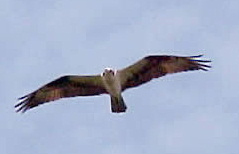 The Osprey population of the Chesapeake Bay region has been adversely affected by the decline of Menhaden, a small fish, along the Atlantic coast. The Chesapeake has one of the largest breeding populations of Osprey anywhere, with close to 4,000 pairs. Within the last decade, researchers have found increasing numbers of malnourished and dying chicks. They argue that this is because the Ospreys' preferred food, Menhaden, has declined sharply over the past two decades.
Menhaden filter the bay's waters by eating the microscopic plants and animals that consume dissolved oxygen needed by other aquatic life. In turn, they're a primary food source for sport fish, such as striped bass, bluefish and weakfish, and seabirds, including loons, gulls and gannets.
Ongoing scientific research focuses mostly on the ecological role that menhaden fill underwater. Broader public awareness has centered on the fish's importance to recreational anglers. But, like striped bass, ospreys favor meals of menhaden over other fish.
"Of everything we know about the bay, this is one of the fundamental food chains: Ospreys eat menhaden," said Paul Spitzer, a Maryland ecologist who specializes in birds.
One study found that menhaden made up 70 percent of the diet of ospreys nesting on Mobjack Bay off the coasts of Gloucester and Mathews counties.
Other studies done along the Atlantic coast have turned up similar results.
Menhaden swim in large schools that skim the water's surface, and they move straight ahead rather than dart around like other fish.
That makes them a perfect prey for circling ospreys, as well as Omega Protein's spotter planes, which radio a school's coordinates to waiting boats.
A fishery commission is considering imposing limits on harvesting of Menhaden while more research is done to determine the causes of the fish's decline.
Sunday, August 13, 2006
Trip Report: Delaware Marshes
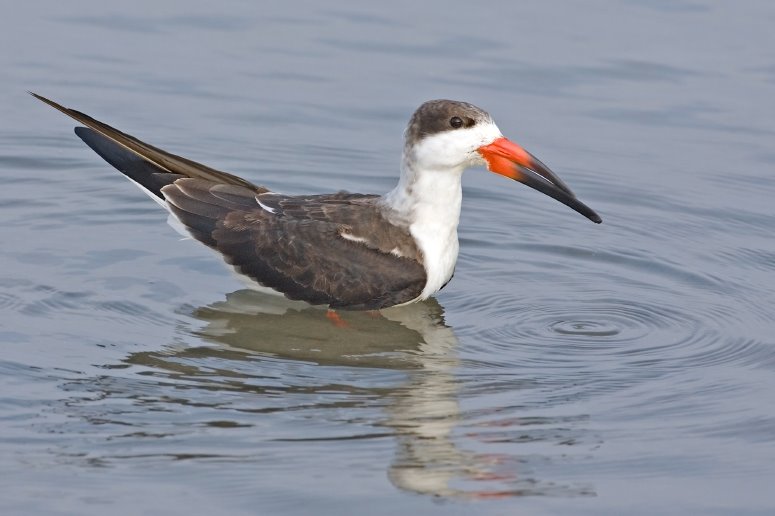
Four Audubon members set out from Washington on August 12 to look for late summer birds. The day was perfect for birding: high around 80, clear, and breezy. We set our sights on Bombay Hook National Wildlife Refuge. This refuge, which sits at the edge of Delaware Bay, consists of close to 16,000 acres of tidal salt marsh, together with several freshwater impoundments and upland hardwood forest. The diversity of habitats makes it possible to find many species of birds, especially during migration. Bombay Hook is a fine place to bird in any season, but is at its best during spring and fall migration. For a Washington-based birder, the attraction of this refuge is the ability to see many species of shorebirds that are hard to find at inland locations.
Read More...
Wednesday, August 09, 2006
Field Trip This Saturday
Join DC Audubon on Saturday, August 12, for its annual late summer field trip to Bombay Hook National Wildlife Refuge and the Delaware Marshes. During this trip we hope to see herons, shorebirds, and terns as they end their breeding season and begin their journey south. In addition, the marshes and woods of the refuge boast many resident species. One can see purple martins and blue grosbeaks near the visitor center, and other Eastern Shore specialties like seaside sparrow and marsh wren breed along the boardwalk trail. On our May field trip this year, we saw over 100 species in and around Bombay Hook. We may not reach that total on this trip, but we should see many beautiful and interesting birds during our trip through the refuge.
For a more recent account of Bombay Hook by a local birder, see here.
For directions and RSVP information, see our webpage. (It is important that you contact the trip leader as soon as possible if you intend to come.)
For a more recent account of Bombay Hook by a local birder, see here.
For directions and RSVP information, see our webpage. (It is important that you contact the trip leader as soon as possible if you intend to come.)
Sooty Shearwaters Have Longest Migration
According to new research, sooty shearwaters make the longest known migration. The birds travel close to 40,000 miles each year from their breeding grounds around New Zealand to their wintering grounds in the North Pacific. That way, the birds can take advantage of the summer in both the northern and southern hemispheres. Scientists were able to track this route using electronic tracking tags.
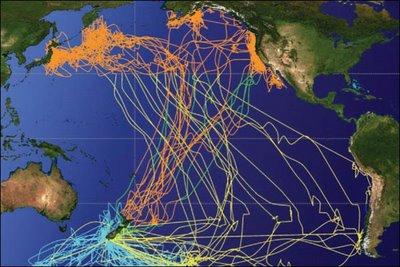 Blue = Breeding season activity
Yellow = Flight north
Orange = Wintering activity and flight south
Between January and March 2005, 33 birds at two breeding colonies in New Zealand were fitted with tags weighing 6g, allowing researchers to track their journey.One interesting result of the study is that individual birds do not travel around the circumference of the Pacific, as previously thought. Instead they travel quickly to one of the winter feeding grounds, located near California, Alaska, and Japan, and then return quickly to their breeding grounds at the end of the southern winter. Below is a map showing the travels of the 19 shearwaters with working tags.
In the autumn of that year, 20 of the tags were recovered when the birds returned to their burrows at the breeding grounds; 19 of the devices had successfully recorded the bird's movements.
Data showed that some birds travelled up to 910km (565 miles) in a day, and dived to depths of 68m in their search for food.
 Blue = Breeding season activity
Yellow = Flight north
Orange = Wintering activity and flight south
Saturday, August 05, 2006
Tracking Bees, Bugs and the Birds That Love Them

(From NPR) For decades now, ecologists have been attaching radio transmitters to the bodies of large animals: whales, bears, elephants, condors and eagles for starters. What these scientists haven't done is stick the same devices onto animals like song birds and big insects, those migratory flying things that sometimes mow down crops and spread diseases.
For eight years now, Wikelski's been the leader of a group of scientists who do collect those data points, with the help of radio transmitters no bigger than a baby's thumbnail. These scientists are known as "microtrackers" and for now they're few and far between.
But Wikelski's work is changing that by forcing ornithologists to change the way they think about migration. His first microtracking studies started nearly a decade ago when Wikelski captured groups of mid-Western thrush and glued extremely sophisticated radio transmitters to the bellies of these birds.
"The transmitters recorded heartbeat, breathing, wing beats and location," he said. "Once every second, they sent all this information out in concentrated bursts."
Wikelski says we know very little about how small animals migrate. Scientists would find out where birds are born and where they die. They would discover where birds are making pit stops on their trips home. And they would be able to track locust swarms and birds that could carry avian flu across international boundaries.
Wikelski turned the focus of his research to flying insects. With the help of prominent entomologists like Mike May of Rutgers University, he's been attaching even smaller transmitters to the backs and bellies of insects. Listen and read more on NPR.
Tuesday, August 01, 2006
Pesticide Action Alert
The following came from the American Bird Conservancy (via Birderblog).
URGENT - We have 24 Hours to Stop the Most Deadly Pesticide to Birds
The U.S. Environmental Protection Agency (EPA) is poised to make a decision on whether to ban the bird-killing pesticide, carbofuran. This is the most deadly pesticide to birds currently being used in the United States. It is more toxic than DDT. A single drop is enough to kill a bird.
We have just learned that because of pressure from the manufacturer, FMC corporation, the EPA may make the wrong decision and elect to keep this pesticide on the market. We have 24 hours to counteract the industry pressure. We need your help.
We ask you to email carbofuran@epa.gov, CCing gshire@abcbirds.org telling the EPA to ban carbofuran now because of its danger to birds, other wildlife, and people. Your email can be brief. Use the talking points provided below to help. What is important is that you tell them in your own words that you do not want carbofuran to be used in the United States. Alternatives exist that are equally effective and not deadly to birds. There is no reason to keep carbofuran registered.
Please send your email before 5pm Wednesday August 2, 2006!
Alternatively you can fax your comments to 202-564-0512.
Thank you for taking this emergency action on behalf of birds and wildlife,
George Fenwick
President, American Bird Conservancy
We provide the following talking points to help you let EPA know why this chemical must be banned:
- All legal uses of carbofuran kill birds resulting in potential violations of the Migratory Bird Treaty Act (MBTA) every time it is applied. Farmers are placed in jeopardy of violating the MBTA whenever carbofuran is used, even if
they follow the label directions.- Carbofuran is very toxic to people. Human risk assessments have been done three times and they show greater risks to farm workers each time they are refined. These studies indicate that carbofuran is too dangerous to use.
- Carbofuran is so toxic it kills all the beneficial insects as well as pests with the result that integrated pest management cannot be done.
- Carbofuran is so toxic that no crop rotation can be performed for ten months after application. This eliminates the possibility of crop rotation as a tool for reducing insect damage to crops.
- Alternative chemicals exist for all crops except artichokes. Many alternatives exist for corn. Only a very small percentage of corn produced in the U.S. uses carbofuran now because of its environmental effects and safety issues.
- New insecticides have been developed for rice, cotton, corn, and other crops specifically to replace carbofuran. Most of these are reduced risk chemicals presenting much less bird, wildlife, and human health risks.
- Transgenic corn has been developed specifically for resistance to corn rootworm and European corn borer, further reducing the need for conventional pesticides.
- The United States is a world leader in pesticide regulation. Cancellation of carbofuran will send a strong message to Latin America, Canada, and Mexico about the dangers of this pesticide. This will help save birds in those countries when they phase out carbofuran. Canceling the tolerances of pesticide residues on foods will immediately limit the use of carbofuran in all countries that export to the US.
Helping Birds in a Summer Heat Wave
During heat waves like the current week's, many birds suffer from heat illness, just like humans. To keep cool, birds will seek shade, pant, hold their wings away from their body, and bathe. You can help the birds around your home deal with the heat by taking a few steps.
- Provide sources of water for drinking and bathing. Remember that smaller birds prefer shallow water. Some ideas for providing water are here. Empty and refresh the water to keep it clean and free of mosquito larvae.
- Clean hummingbird feeders and refresh their sugar water regularly. Very warm conditions can lead to the growth of dangerous bacteria and fungi.
- Keep any seed feeders clean of refuse where germs could breed and spread.
Remember to keep yourself safe by following the CDC's heat illness guidelines.
Monday, July 31, 2006
100 Years of Club Plummers Island

The Washington Post Features the The Washington Biologists' Field Club which is celebrating 100 years of self-professed geekdom (six years late) this year, with a 150-page volume summarizing a century of counting every living thing on Plummers Island, the club's buggy, overgrown paradise a few steps into the Potomac, just downriver from the American Legion Bridge.
Established in 1901 as a weekend retreat, Plummers Island, called by the field club "the most thoroughly studied island in North America," today represents one of the most comprehensive, longest-running biological inventories in the country.
Scrambling over Plummers Island's rock and scrub, club members have documented every living thing known to have existed there. To date, that includes 885 species of vascular plants, 70 mosses and 597 beetles -- not to be confused with the five different cockroaches they have found
The stories begin in 1899, when botanist Charles Pollard formed the Washington Biologists' Field Club, and began the search for a suitable field camp.
In 1901, the group leased Plummers Island, which it bought seven years later. For about $200, the members built at its rocky pinnacle a wooden cabin with few amenities beyond a big fieldstone fireplace and lean-to kitchen.
At the time, the island was a mix of untended farmland, forest, rock and shoreline. The blend drew plenty of creatures and plant life, and the members began collecting, each in his area of expertise.
For about three decades, Shetler has collected plants on the island. Opening a steel cabinet down the hall from his Smithsonian office, he flipped through yellowed folders. Inside rested mistflower specimens collected as early as 1917, the vivid blue blossoms on some still colorful.
*Washington Biologists' Field Club Website
Friday, July 28, 2006
High Levels of Mercury in Wood Thrush
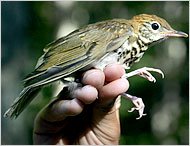 A study of songbirds in upstate New York has revealed very high levels of mercury in 178 species, with the highest levels being in wood thrushes.
The presence of mercury in lakes and streams is already well documented, and the New York Department of Health advises people to restrict the consumption of any freshwater fish caught in most of the state to no more than one meal a week.
But Dr. Evers is one of the first scientists to test for wildlife mercury contamination beyond fish. He began his work in this area in 1998 and found that common loons, which eat fish, had highly elevated levels of mercury that made them lethargic and caused their reproductive rates to drop.
He then decided to study songbirds, which never eat fish. In particular, he wanted to study the wood thrush, a small bird with a distinctive song that was once common throughout the Northeast. The population of wood thrushes has declined 45 percent in recent decades.
It was once thought that destruction of the bird’s forest habitat was responsible for the decline. But Dr. Evers now suspects that mercury contamination might be a factor, along with the wide-ranging negative effects of acid rain on the forests....Dr. Evers’s work suggests that when mercury falls on land, it is absorbed by soil and by fallen leaves that are consumed by worms and insects. Songbirds then feed on the bugs, absorbing the mercury.
While all the birds he tested last year had mercury in their blood, wood thrushes had the most, Dr. Evers said, an average of 0.1 parts per million. That is below the federal safe standard for fish (0.3 p.p.m.) but high enough to affect the birds’ reproductive cycle.
With fewer songbirds to eat potentially harmful insects, the state’s forests would be at greater risk for damage by gypsy moths and other pests, Dr. Evers said.
Beyond that, mercury leaching into soil could find its way into the food chain in ways that are still unknown, he said.
Subscribe to:
Posts (Atom)

