Showing posts with label Bald Eagle. Show all posts

Wednesday, August 30, 2006

Bald Eagle in Baltimore

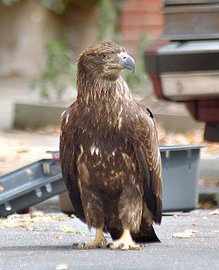
An immature bald eagle caused a stir in Baltimore today by landing on a city sidewalk in a residential neighorhood. It walked around on the sidewalk and the street for an hour and a half. Residents assumed that something was wrong with it and had called the Maryland Department of Natural Resources to send a wildlife rescuer. But before this could be arranged, the eagle flew away.

The Sun article provides two possible explanations from local wildlife experts. One focused on a possible injury.
"Why the heck it would stand around on Bolton Street for an hour? Who knows?" said Glenn Therres, associate director of the Wildlife and Heritage Service at the Maryland Department of Natural Resources. "I don't know if it flew into something and was dazed for a while. It could have been injured, but the fact that it flew away suggests the injury might not have been that severe."

At any given time, there are about 2,000 bald eagles in Maryland, Therres said. The eagles nest along the shores of tidal waters in the region, but the birds - which were upgraded to threatened from endangered in recent years - rarely if ever hang out on city sidewalks, Therres said.

"There are a lot of them floating around, acting like teenagers and juveniles, just kind of looking for a good place to eat or to socialize with other birds their own age," Therres said. "A wooded shoreline on the Potomac or Susquehanna [rivers], but not normally in an urban neighborhood in Baltimore City."
A second explanation is that it was merely resting.
David Curson, director of bird conservation for the Maryland and District of Columbia branch of the National Audubon Society, said the bird might have eaten a large catch of fish and was too stuffed and lazy to move.

"It's difficult to explain, but one possibility is, it may have eaten a large meal," Curson said. "Sometimes, when a bird like that eats a large meal like that it gets weighed down. But without knowing all the facts and not having seen the bird myself, it's difficult to be sure."

Tuesday, February 14, 2006

Off The List


The bald eagle is shown in Homer, Alaska on Saturday, Feb. 5, 2005.
(AP PHOTO)
(WASHINGTON POST) The proud symbol of a nation for more than two centuries, the iconic and elegant American bald eagle also is emblematic of a snail-paced federal bureaucracy.

Seven years after the government said the fierce raptor is no longer threatened with extinction, officials finally have a plan for removing it from the endangered species list.

Officials said Monday's action could lead to the bald eagle coming off the endangered species list within the next year or so.

"Should the eagle be delisted, we expect that the public will notice little change in how eagles are managed and protected," said H. Dale Hall, the Fish and Wildlife Service's director.

Hall said at least 7,066 known nesting pairs now exist in the contiguous United States. The bald eagle's territory stretches over much of the North American continent. Tens of thousands more live in Alaska and Canada, where their existence never was imperiled.

However, 43 years ago, there were just 417 known nesting pairs left in the lower 48 states, mainly because of the widespread use of DDT and other pesticides that weakened the bald eagle's eggshells and reduced its birth rate. The brown-bodied bird with the distinctive white head and tail also suffered from lead poisoning _ eating waterfowl pierced by a hunter's lead shot.

In 1967, under a law that preceded the Endangered Species Act, the bald eagle was declared an endangered species in the lower 48. In 1972, the Environmental Protection Agency banned DDT for most uses.

Fish and Wildlife officials in 1978 listed the bald eagle as endangered in 43 states and threatened in Washington, Oregon, Minnesota, Michigan and Wisconsin. The government hatched detailed recovery plans, with specific population and reproduction goals. Sometimes eggs were imported from Canada and installed at artificial eyries.


By 1995, the species had rebounded enough to be reclassified as threatened throughout the lower 48.

If and when the bald eagle is removed from the endangered list, two other laws will continue to protect it: the 1918 Migratory Bird Treaty Act and the 1940 Bald Eagle Protection Act, later revised to include the golden eagle. But those don't address habitat.

Tuesday, September 20, 2005

Saving The Symbol

USFWS photo

The Smithsonian Magazine takes a look at endangered species, like our nation's symbol, the Bald Eagle, that have been given a second chance thanks to tough laws, dedicated researchers, and are making their way 'back from the brink.'

The Efforts to safeguard the nation's natural heritage culminated in the 1973 Endangered Species Act (ESA), signed into law by President Richard Nixon. It requires federal authorities to identify threatened or endangered animal and plant species and to help them recover, often by restricting how their habitats may be used.

In 1782, the Second Continental Congress incorporatedthe bald eagle into the first great seal of the United Statesas a symbol of “supreme power and authority.” Unlike the king’s England, where wildlife was the exclusive property ofroyalty, in this new nation wild animals belonged to all the people.

By the 1930s, the national symbol was in trouble. Bald eagles, once soaring over most of the country by the hundreds of thousands, had plummeted in number to an estimated10,000 pairs by the 1950s.

Hunting, land clearing and accidental poisoning (eagles often ate toxic meat set out by ranchers to kill wolves and other predators) contributed to the decline.

In 1940, Congress jumped to the fore with the Bald Eagle Protection Act that stated, “The bald eagle isno longer a mere bird of biological interest but a symbol ofthe American ideals of freedom.”

But the introduction of DDT in 1945 dealt the animal acritical blow and by 1963, only 417 baldeagle nesting pairs were found in the lower 48.

Today, with about 7,678 pairs of bald eagles in the lower 48, the bird awaits a final OK to be taken off the ESA’s threatened list.

Status: Threatened, awaiting removal from list
Year declared endangered: 1940
Lowest count in lower 48 states: 417 nesting pairs

* Smithsonian Magazine Story
* American Bald Eagle Foundation
* U.S. Fish & Wildlife Service Website
* Listen and learn about the Baby Baldies


Endangered Species Act Endangered?

Congress is considering proposed changes to the 32-year-old Endangered Species Act that would get the government out of the business of setting aside critical habitat for threatened plants and animals.

That would eliminate a central element of the landmark law.

An overhaul of the Endangered Species Act, proposed by Rep. Richard Pombo, R-Calif., was going before the House Resources Committee on Wednesday. Pombo, the committee's chairman, wants his panel to vote on it Thursday and he hopes the full House will consider it next week.

Environmentalists fear that eliminating the government's ability to establish critical habitat would take away a key to species survival.

*Read more in the Washington Post story