Interested in being a volunteer birder for Manassas?!?!
Please contact Carolyn Williams at cwilliae@gmu.edu or 703.273.1961.
I coordinate the Northern Virginia Bird Survey (NVBS), The Audubon Society of Northern Virginia's breeding bird point-count now in its 13th year. (Until fairly recently ASNV was called the Fairfax Audubon Society.) This year we lost the services of three of our long-time master birders (team leaders) for Manassas National Battlefield Park (two moved from the area and another was overbooked). I am looking for several master birders (defined as one who can identify by sight or sound all the bird species one would expect to encounter in N. Va. during June) to replace them. Our count protocol is a simple one, a one-time, five-minute count at each 250-meter (about 0.15 mile) grid point. The count is done between dawn and about 8:30 a.m. in June.* Master birders can survey alone or with one or more assistants, but only the master birder identifies the birds to be logged in. Information collected includes species, number of individuals, evidence of breeding activity (using codes), date and time of the count, sky and weather conditions (using codes). Flyovers are indicated. Survey instructions, detailed field maps, and data sheets will be provided. About sixty points are involved, and of these twenty-nine have been GPSed. You can survey as many of the points as you like. I am pushing the GPSed points as they have been surveyed the longest. They are located in the north central part of the park.
*Under the circumstances, I think we can extend the deadline to at least July 7.
For further information contact Carolyn Williams at cwilliae@gmu.edu or 703.273.1961.
Thanks.
Carolyn
Showing posts with label Birding. Show all posts
Showing posts with label Birding. Show all posts
Thursday, June 29, 2006


Tuesday, May 30, 2006
The President Taps A Birder
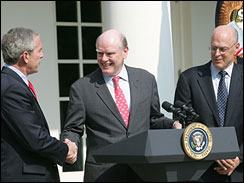 (AP Photo/Pablo Martinez Monsivais)
Treasury Secretary John Snow resigned Tuesday and President Bush nominated Goldman Sachs Chairman Henry M. Paulson Jr. to replace him.
The Washington Post reports that Paulson is a birdwatcher who can often be found in Central Park with his binoculars, he is known as a conservationist also serving as co-chair of the Asia/Pacific Council of the Nature Conservancy, and the chair of The Peregrine Fund, which works to conserve wild populations of birds of prey.
In an article in CNN Money/Fortune Paulson was approached by the Nature Conservancy in 2001 to serve as its CEO. "The timing isn't right," Paulson said then. Now instead he takes the helm of Treasury.
* CNN Money/Fortune article on Paulson's Secret Life
* Article in The Washington Post
* Financial Times Profile
* Remember these birds at the Treasury
Saturday, May 06, 2006
DC Audubon BIRDATHON 2006
Audubon Society of the District of Columbia
BIRDATHON 2006
May 13, 2006
Celebrate the diversity of resident and migratory bird species on International Migratory Bird Day (http://www.birdday.org/) by participating in a fund-raising Birdathon to benefit the Audubon Society of the District of Columbia.
The Birdathon counting is between 5:00 a.m. through midnight. Teams will count American Bird Association (ABA) recognized species of birds within the terrestrial and nautical boundaries of the District of Columbia. Birds seen on the boundary lines with MD and VA will count.
Rules are the same as the 2005 ABA Big Day Rules with the exception of the time of the Birdathon and each bird species must be seen or heard by 2/3 of the team members. If you are a team of only two members, you both must identify the bird.
To refer to the additional rules visit here:
http://www.americanbirding.org/bigday/2005bigdayform.pdf
All teams must seek pledges for donations to the Audubon Society of the District of Columbia. Non-residents of DC may participate. Non-members of the Audubon Society of the District of Columbia may participate. Participants are recognized when their lists are submitted no later than May 20. There is no entry fee. Please create a team name and enter it with your submission. We are operating on the honor system for sightings, but the Society has the right to question and challenge unusual sightings.
Typically, ask for a pledge per bird seen or heard and tell your donors how many species you hope to target.
Winners – everyone that cares about bird conservation is a winner, but the team with the most sightings will be recognized on the Audubon Society of the District of Columbia’s Web site. Please include a team picture and your names with your submission so that you may bask in the glory of your victory.
Make checks payable to the Audubon Society of the District of Columbia.
Submit checks, team information and final counts using the ABA form to the following:
Send checks to Audubon Society of the District of Columbia, c/o Denise Ryan, Treasurer
5726 Lockwood Rd, Cheverly, MD 20785
Participation or rules questions to Denise Ryan at savetheocean@yahoo.com
Thursday, January 19, 2006
Great Backyard Bird Count
The Christmas Bird Count season may be over, but there is still plenty of time for birdwatchers to participate in citizen science projects this winter. Coming up on February 17-20, 2006, is the ninth annual Great Backyard Bird Count, a joint project of the National Audubon Society and the Cornell Lab of Ornithology.
To participate, select one block of time during the count period to watch birds in your backyards. While you are watching, make note of what species you see, how many individuals there are of each species, and how long you counted. Then submit your data here: http://www.birdsource.org/gbbc/. If you do not have a backyard, as is the case for many urban residents, you are still encouraged to participate by counting birds in a local park or along your street. Every bit of data helps, and the more ground covered, the better.
Like the Christmas Bird Count and other citizen science projects, the Great Backyard Count provides scientists with important bird population data. Scientists have been able to track declines of some species, and changes in the wintering range of other species, thanks to the data collected in this project.
Saturday, September 17, 2005
Twas A Swift Night Out

A SWIFT NIGHT OUT is a continent-wide effort to raise awareness about and encourage interest in Chimney Swifts and Vaux's Swifts. The project was originally inspired by John Connors with the North Carolina Museum of Natural Sciences in Raleigh, North Carolina.
As summer draws to a close and the swifts have finished raising their young, these aerial acrobats begin to congregate in communal roosts prior to their migration in the fall. Some roosts may consist of an extended family group of a half a dozen birds or so, but the larger sites can host hundreds or even thousands of swifts!
Here is how it works: Spotters kept their eyes to the skies at dusk in late July and watched for areas where swifts were feeding. They looked for a tall shaft, chimney or similar structure to locate where Chimney Swifts (central to east coast) or Vaux's Swift (Pacific coast) go to roost in their area.

On one night over the weekends of August 12, 13, 14, and / or September 9, 10, 11 spotters observed the roost starting about 30 minutes before dusk and estimate the number of swifts that enter. They sent their numbers in to the North American Chimney Swift Nest Site Research Project.
The DC Birding Blog spotted a swift site around the corner of Massachusetts Ave and 3rd St, NE read here.
* Chimney Swift Webcam
* More on The Chimney Swift
Saturday, August 06, 2005
Behind The Binoculars...Terrorist Or Birder?
 Source: humblewildlife.com
Popular birding sites across the country, are facing stricter regulations -- in some cases being required to hire a police escort -- as authorities beef up national security.
Since the terrorist attacks of Sept. 11, 2001, Americans have been subject to increased government restrictions and scrutiny at airports and elsewhere. That bird-watchers have become a target is somewhat surprising, since all they do is ''walk quietly through the woods," as Brinkley put it.
But those woods are often around military bases, wastewater management plants, and dams -- places where government authorities fear that terrorists disguised as birders could lurk or strike.
And the equipment they carry -- binoculars, telescopes, and cameras -- can make birders look suspicious at first glance.
Birding at the Chesapeake Bay Bridge-Tunnel used to require only an annual permit that was easily available via mail, telephone, or fax; about 800 were distributed annually. To enter any of the three northern islands, which are not open to the public, a birder would only have to show the permit, a photo ID, and vehicle registration. The southernmost island, which has a restaurant and a fishing pier, is open to the public.

''Anyone could stop [on the islands]. We had no idea who was on the islands and who was not," said Clement Pruitt, director of operations and chief of police for the Chesapeake Bay Bridge-Tunnel.
But earlier this year, after Virginia's Department of Transportation determined that the ventilation buildings on each of the four islands were poorly secured, fences were erected around the buildings, and the three northern islands were closed to all but employees.
Under the rules, which took effect Friday, individuals or groups of no more than 15 people will have to arrange their visits in advance and pay $50 an hour to be escorted by an off-duty police officer. Upon arrival, all birders must provide photo identification and vehicle registration. Their belongings and vehicles may be examined at check-in and at any time during the visit.
''These sorts of national security issues seem to be intruding in ways one would never have expected. You expect airline security. You don't expect it when you go birding. Who knew you'd have a police escort?" said Perry Plumart, director of conservation advocacy for the American Bird Conservancy. (LA TIMES article via Boston Globe)
* The Chesapeake Bay Bridge-Tunnel Website
Friday, June 03, 2005
Preserves For Birds

Fraser Preserve
Courtesy: The Nature Conservancy
The Nature Conservancy’s preserves are set aside to protect natural plant and animal communities, including those of the winged variety. A map of preserves in the Maryland/DC Area can be seen here. Virginia's preserves are listed here.
Best for Birders:
Nanjemoy Creek provides a nesting home to one of the largest great blue heron colonies on the East Coast. Approximately 1,000 pairs of herons return each year on or around Valentine's Day to bring in the next generation of this species--the East Coast's largest wading bird, standing four feet tall with a six-foot wing span.
The Fraser Preserve boasts about 110 species of birds, including 39 nesting species and the bald eagle. Among the nesting birds are the red-shouldered hawk, ruby-throated hummingbird, downy woodpecker, scarlet tanager, and blue-gray gnatcatcher. There are also over 300 varieties of wildflowers. The natural habitats found in the Piedmont region, include clear fast streams, lush cold-spring swamp, marsh, mature hardwood forests, open meadow, ponds, river and stream floodplain forests and thickets, steep rocky bluffs, springs and seeps, and various stages of old field succession. The terrain slopes toward the Potomac River, which forms the northern boundary of the preserve.
At Helena's Island Preserve bird species far outnumber mammals and reptiles. Solitary sandpipers, ospreys, teal, mallards, and mergansers can be seen during the spring and fall migration. A number of species regularly visit or inhabit the island, including American redstart, northern parula, Carolina chickadee, green-backed heron and spotted sandpiper.
Blackwater River Preserve has one of the best remaining examples of an ancient baldcypress forest in the Southeast. Biologists estimate that some trees at this preserve are more than 800 years old. The prothonotary warbler as well as various other species pass through here.
Fernbrook Natural Area is an excellent example of a southern Piedmont forest in varying stages of succession. At an elevation of about 400 feet above sea level, the preserve includes examples of mature upland and lowland hardwood forests, a successional oak-pine forest, as well as a small tract of southern pines. Birds sighted here include the pileated woodpecker, ovenbird, scarlet tanager, ruby-throated hummingbird, and the red-tailed hawk. Bobcats have been known to wander through the area.
D.C. Bound:
Bear Island/Potomac Gorge, a natural monument in the shadow of national monuments, The Potomac Gorge—the 15-mile section of the Potomac River from above Great Falls south to Theodore Roosevelt Island—is one of the most significant natural areas in the entire National Park System. The Potomac Gorge site includes the well-known Billy Goat Trail- 2 miles of strenuous hiking. Access to the site is controlled by the National Park Service, who manages C&O Canal National Historical Park.
Wednesday, May 11, 2005
Naturalist Walk In Rock Creek Park

Early May is an exciting time for bird enthusiasts. It's when thousands of migratory birds fly through the Washington area, and help usher in the warm weather with their unique calls and songs. WAMU's Sarah Hughes accompanied the Audubon Naturalist Society's Stephanie Mason on a walk through Rock Creek Park, to seek out some of these newly arrived visitors.
The Naturalist Society conducts a free walk for beginning birders every Saturday morning.
Listen to the walk through the park on NPR.
For more information, visit Audubon Naturalist Society website.
The Naturalist Society conducts a free walk for beginning birders every Saturday morning.
Listen to the walk through the park on NPR.
For more information, visit Audubon Naturalist Society website.
Monday, April 25, 2005
End Of Civil War Makes Way For Birders In Angola

Bird Life International: Ian Sinclair
The first ornithologists to visit northern Angola since the end of the country's civil war have 'rediscovered' three species of bird not seen for decades, a conservation group said on Wednesday. The six-day expedition at the end of January yielded sightings of the orange-breasted bush-shrike and the white-headed robin-chat, two small birds not been seen by scientists since 1957. (Reuters Story)
* Story from Bird Life International
* Story from Bird Life International
Monday, April 04, 2005
Join The Neighborhood Nestwatch

Every spring, birds breed in our backyard. Some of these birds have survived the winter here while others have made the difficult trek from the tropics and the southern United States.
Team up with the Smithsonian Environmental Research Center and gather data by peeking into the backyard love lives of your neighborhood birds. Follow a their lifestyles as they build nests, lay eggs, and raise their chicks and maybe even return each Spring.
Eight species of birds are monitored by Neighborhood Nestwatch:
· Northern Cardinal (Cardinalis cardinalis)
· American Robin (Turdus migratorius)
· Northern Mockingbird (Mimus polyglottis)
· House Wren (Troglodytes aedon)
· Gray Catbird (Dumatella carolinensis)
· Carolina Wren (Thryothorus ludovicianus)
· Song Sparrow (Melospiza melodia)
· Carolina Chickadee (Parus carolinensis)
Have you seen any of them in your backyard?
Rock Creek Park, a sort of backyard for the District, has been a part of the Nestwatch in the past. The data collected is available in the Smithsonian website here.
Thursday, March 17, 2005
District Counts 59 Species in "Backyard Bird Count"

In this year's Great Backyard Bird Count over 50,000 checklists were submitted nationally, where more than 6 million individual birds were counted and with over 600 species accounted for in all. In the District of Columbia a total of 59 species were reported out of 5,162 total birds spotted.
District of Columbia Results.

Wednesday, March 09, 2005
A Garden That Extends An Invitation To Perch

Photo Source: http://www.gardenlerner.com/
In his weekly Washington Post "Green Scene" column local Landscape designer Joel M. Lerner advises on how to design a garden appealing to visitors.
Water
A pond or other water feature will draw all kinds of living things. If the water is clean, moving in some fashion or contains fish, it will not be a habitat for mosquitoes, but it will bring birds, dragonflies, butterflies and frogs. An in-ground pond can also attract small mammals, such as raccoons and rats. It might also appeal to an occasional exotic visitor. A friend's pond was just cleaned of fish by a passing heron; they might need to install a net to protect the fish. An elevated fountain or birdbath will appeal mostly to airborne visitors, such as birds and butterflies.
Food
When it comes to food, birds vary widely in what they prefer. Some birds, including robins and flickers, eat crawling insects and thrive where there are lots of worms to be had, such as in beds and lawns that contain lots of leaf mold or other composted organic material.
Robins, mockingbirds, catbirds, finches and sparrows like berries. Some of the best plant to provide this treat are serviceberries, hollies, hawthorns, bayberries, dogwoods and viburnums. Birds go for seeds. Colorful goldfinches, mourning doves, house finches and native sparrows are partial to seeds from perennial and annual flowers, such as zinnia, chicory, black-eyed Susan, purple coneflower, thistle and gaillardia. Some species feed in flocks -- robins, wrens, finches and cardinals among them -- so if you provide a lot of food, you might actually create a bird haven and get more visitors than you ever imagined.
Hummingbirds are a special case. They are nectar feeders and love tubular flowers such as honeysuckle, trumpet vine and bee-balm (Monarda). They're also very fond of red. They will also come to hummingbird feeders containing a nectar-like liquid. If they get used to feeding around you, they can be absolutely fearless and will even come to a flower in your hand.
http://www.washingtonpost.com/ac2/wp-dyn/A7884-2005Mar4?language=printer
The North American Birdfeeder Guide, a new book co-authored by Steve Kress and Robert Burton, explains how to attract, feed, and identify birds you see in your gardens.

Best Bets For March Birding
Hughes Hollow
Visitors to Hughes Hollow should be advised that hunting is permitted there & they should probably restrict visits to Sunday.
Seneca (Riley's Lock) on the C&O Canal
Almost any place along the Canal is productive.
Huntley Meadows (good for beginners)
Huntley is not as strong a contender since the beaver dam broke; the main pond is no longer deep enough to attract many waterfowl, but you could round it off by visiting Dyke Marsh nearby.

United States National Arboretum
Photo courtesy of the DC SHPO
Within DC
Kenilworth, the Arboretum, and Hains Point are good choices.
If you are a special fan of waterfowl, try Jug Bay in Maryland, or Mason Neck and Belmont Bay in Virginia.
The DC Audubon Website has more local hot spots.
Claudia Wild's book 'Finding Birds in the National Capital Area,' 2nd ed. If you are more experienced, the 'Yellow Book' from MOS is useful as is keeping an eye on the MDOsprey listserv.
Links to other Maryland and D.C. birding links can be found here.
Tuesday, March 08, 2005
Birder Ban Breeds Contempt
The Washington Post reports that security concerns at the Chesapeake Bay Bridge-Tunnel have prompted officials to propose a ban on bird-watching from most of the 20-mile span between the Eastern Shore and Virginia Beach, and distraught birders are waging a phone and fax campaign against it.

Photo Credit: Steve Earley -- The Virginian-pilot
The Chesapeake Bay Bridge-Tunnel is popular for its large mix of birds and four manmade "islands" for viewing.
Photo Credit: Steve Earley -- The Virginian-pilot
The Chesapeake Bay Bridge-Tunnel is popular for its large mix of birds and four manmade "islands" for viewing.
The area that some birders call the "Serengeti of the East," because of the large and unusual mix of birds drawn to the 40-year-old bridge-tunnel, is flanked by the Chesapeake Bay on the west and the Atlantic Ocean on the east. Birders have had unusual access to ocean birds because they can park on four manmade "islands," one at each end of the two, mile-long tunnels where the span dips beneath the bay.
http://www.washingtonpost.com/wp-dyn/articles/A15599-2005Mar7.html
Tuesday, March 01, 2005
An early Common Nighthawk
DC AUDUBON SOCIETY
Recently, a Common Nighthawk was seen very clearly in town. Would anyone have an idea why this nighthawk may be migrating so early?

Recently, a Common Nighthawk was seen very clearly in town. Would anyone have an idea why this nighthawk may be migrating so early?
Sunday, February 27, 2005
Lapwing Chasing
The Lapwing may be long gone by now, but in mid February regional birders were hoping to add the bird to their life list.

The Washington Post wrote "Not since Shrimpy the kelp gull blew in to Maryland from South America in the 1990s has this region played host to such a rare, well-traveled and positively unusual species. "
Please add a comment if you have a story about spotting the illusive bird.
http://www.washingtonpost.com/wp-dyn/articles/A30772-2005Feb16.html
Please add a comment if you have a story about spotting the illusive bird.
http://www.washingtonpost.com/wp-dyn/articles/A30772-2005Feb16.html
Subscribe to:
Posts (Atom)

