Tuesday, May 30, 2006

The President Taps A Birder

(AP Photo/Pablo Martinez Monsivais)

Treasury Secretary John Snow resigned Tuesday and President Bush nominated Goldman Sachs Chairman Henry M. Paulson Jr. to replace him.

The Washington Post reports that Paulson is a birdwatcher who can often be found in Central Park with his binoculars, he is known as a conservationist also serving as co-chair of the Asia/Pacific Council of the Nature Conservancy, and the chair of The Peregrine Fund, which works to conserve wild populations of birds of prey.

In an article in CNN Money/Fortune Paulson was approached by the Nature Conservancy in 2001 to serve as its CEO. "The timing isn't right," Paulson said then. Now instead he takes the helm of Treasury.

* CNN Money/Fortune article on Paulson's Secret Life
* Article in The Washington Post
* Financial Times Profile
* Remember these birds at the Treasury

Thursday, May 25, 2006

Red Knots in Decline

The population of North American red knots has been in the midst of a sharp decline for a decade, falling from over 100,000 in the 1980s to 17,000 last year. This year, the numbers have fallen even further. Aerial surveys around the Delaware Bay have counted only 12,000 red knots.

Increased harvesting of horseshoe crabs has been blamed for this species's rapid decline. Before a sudden boom in the horseshoe crab market, watermen took only about 100,000 crabs per year; at the height of crab harvesting in the mid 1990s, about 2.5 million crabs were taken. Horseshoe crabs are used as bait for conch fishing.

Red knots depend upon a plentiful supply of horseshoe crab eggs when they arrive at the Delaware Bay in the midst of their long migration from the southern tip of South America to their breeding grounds in the Arctic Circle. Their migration is timed to coincide with the spawning of horseshoe crabs, when millions of horseshoe crabs come ashore on the beaches to mate and lay their eggs.

Tuesday, May 23, 2006

The Delaware Sparrow

The tidal salt marshes of Delaware, which DC Audubon toured on a recent field trip, are home to a unique subspecies of Swamp Sparrow, the Coastal Plain Swamp Sparrow (Melospiza georgiana nigrescens). This subspecies is small in number and declining due to changes in the vegetation of coastal marshes. Because little is known, the Smithsonian Migratory Bird Center is currently studying the life history of the coastal plain subspecies.

It was only 55 years ago that the coastal plain swamp sparrow was identified and categorized as a subspecies of the more common swamp sparrow, says Shriver. And just last year Smithsonian researchers discovered where the bird winters -- a stretch of marshland from Charleston, S.C., to Beaufort, N.C. It's not a very long trek; most migratory birds fly far greater distances between their winter and summer homes. But Shriver explains that there's one crucial difference between the habitats -- freezes don't occur regularly in the coastal Carolinas. Coastal plain swamp sparrows feed on insects and spiders, which they find by poking around in the mud, so moving 500 or 600 miles south ensures a steady food supply in the winter months.

Mid-May marks the start of nesting season for the coastal plain swamp sparrow and the start of field research. Studies in Chesapeake Bay marshland have shown a steady drop in the number of sparrow nests since the late 1980s. Shriver and Greenberg want to see if that pattern is occurring in Delaware marshes. Coastal plain swamp sparrows like to nest in high marsh, which features a mix of tall and short grassy vegetation with shrubs mixed in. They often attach their nests to the base of the Hide Tide Bush, a common shrub, and then use tufts of Salt Hay to camouflage the nests. Finding these small, well-hidden nests is a bit like finding a needle in a haystack. Fortunately, the female vocalizes a distinctive "chip, chip, chip" call when
leaving the nest.

Coastal plain swamp sparrows like to nest in high marsh, which features a mix of tall and short grassy vegetation with shrubs mixed in. They often attach their nests to the base of the Hide Tide Bush, a common shrub, and then use tufts of Salt Hay to camouflage the nests. Finding these small, well-hidden nests is a bit like finding a needle in a haystack. Fortunately, the female vocalizes a distinctive "chip, chip, chip" call when leaving the nest.

Learn more about coastal plain swamp sparrows.

Sunday, May 21, 2006

Mystery Seabird in DC

Mystery Seabird in Wasington, DC

Peter Vankevich took this photograph on May 13, 2006 on Capitol Hill, Washington, DC. Several excellent birders have had varying opinions as to its identification. Feel to offer your opinion in the comments.

Saturday, May 06, 2006

DC Audubon BIRDATHON 2006

Audubon Society of the District of Columbia
BIRDATHON 2006
May 13, 2006


Celebrate the diversity of resident and migratory bird species on International Migratory Bird Day (http://www.birdday.org/) by participating in a fund-raising Birdathon to benefit the Audubon Society of the District of Columbia.

The Birdathon counting is between 5:00 a.m. through midnight. Teams will count American Bird Association (ABA) recognized species of birds within the terrestrial and nautical boundaries of the District of Columbia. Birds seen on the boundary lines with MD and VA will count.

Rules are the same as the 2005 ABA Big Day Rules with the exception of the time of the Birdathon and each bird species must be seen or heard by 2/3 of the team members. If you are a team of only two members, you both must identify the bird.

To refer to the additional rules visit here:
http://www.americanbirding.org/bigday/2005bigdayform.pdf

All teams must seek pledges for donations to the Audubon Society of the District of Columbia. Non-residents of DC may participate. Non-members of the Audubon Society of the District of Columbia may participate. Participants are recognized when their lists are submitted no later than May 20. There is no entry fee. Please create a team name and enter it with your submission. We are operating on the honor system for sightings, but the Society has the right to question and challenge unusual sightings.

Typically, ask for a pledge per bird seen or heard and tell your donors how many species you hope to target.

Winners – everyone that cares about bird conservation is a winner, but the team with the most sightings will be recognized on the Audubon Society of the District of Columbia’s Web site. Please include a team picture and your names with your submission so that you may bask in the glory of your victory.

Make checks payable to the Audubon Society of the District of Columbia.
Submit checks, team information and final counts using the ABA form to the following:

Send checks to Audubon Society of the District of Columbia, c/o Denise Ryan, Treasurer
5726 Lockwood Rd, Cheverly, MD 20785
Participation or rules questions to Denise Ryan at savetheocean@yahoo.com

Tuesday, May 02, 2006

Trip Report: Cockpit Point Road

Sunday, April 30th, was the inaugural DCA trip to southeastern Fairfax County to Cockpit Point Road. Seventeen hardy birders turned up and the trip was successful although there were logistical snafus and ornithological disappointments. While trying to cut down the unneccessary number of cars the group split. Those who came with me and returned to the embarking spot at the entrance to Cockpit and Possum Point stopped at the power station on the ridge and were treated to great looks at Summer Tanager and Prarie Warbler with a Baltimore Oriole flying into the same tree for some coloration diversity. Orchard Orioles also flitted around to make their presence known. Below in the reservoir, several Bald Eagles held the point with some scurrying around by Spotted Sandpipers and Killdeer below. In the pines Yellow-rumped Warblers abounded and then a Yellow-throated Warbler gave an upclose demonstation of his song, breeding colors, and ownership of his section of trees. House Finches, Goldfinches, Song and Field Sparrows were singing along the shrubs by the power plant and an Osprey carried nesting materials to his perch amidst the power lines.... Read more

Thursday, April 27, 2006

May 4 lecture at the National Zoo: Chivalry Is Dead in Migratory Birds: Lessons From the Winter Season

May 4 – Lecture at 7:30 p.m.

Chivalry Is Dead in Migratory Birds: Lessons From the Winter Season

The relationship between male and female migratory birds during the breeding season appears idyllic: Both members of a breeding pair vie for each other's attention, cooperate to bring food to their nestlings, and, in some cases, even raise a second brood together. Things change dramatically during the winter season in the tropics. There, it's a battle of the sexes. Males compete with females for the best habitats—and usually win. As a result, females suffer lower survival. Peter P. Marra of the Smithsonian Migratory Bird Center will talk about this and other discoveries of his 15-year research program on the winter ecology of migratory birds in Jamaica. This lecture is part of the Zoo's celebration of International Migratory Bird Day.

The lecture is FREE, but please RSVP at http://nationalzoo.si.edu/ActivitiesAndEvents/Lectures/rsvp.cfm. The lecture is in the National Zoo's Visitor Center, just off Connecticut Avenue. Take public transportation, or drive through the vehicle entrance at Connecticut Avenue and park in Lot A.

Tuesday, March 21, 2006

Lady Whipbirds Sing With An Accent


From The Discovery Channel: A Scotsman with a heavy brogue may speak the same language as a Texas cowboy, but each has a distinct accent; now researchers have discovered that female whipbirds in Australia sing the same basic songs, but with regional accents.

Female birds in general rarely sing, so that find itself is unusual. The determination is doubly noteworthy because the scientists observed that the males of this species, Psophodes olivaceus, sing with no accent whatsoever.

Mennill and his colleague Amy Rogers measured eastern whipbird recordings from 16 different populations along the east coast of Australia. For each of the 112 birds that they recorded, they measured the song's number of syllables, the length of the first syllable, the highest and lowest frequency of the last syllable, the time between these frequency extremes and other characteristics.

The vast majority of female recordings showed variations on each of these criteria, but male songs were all virtually identical.

In terms of accents, he said that geographical variations, or dialects, are found in other songbirds, whales, seals and primates.

Findings were published in a recent issue of the Journal of Avian Biology.

*Female 1

Field Trip to Hughes Hollow

We had a bright, clear day, if a chilly one, for DC Audubon’s annual “First day of Spring (one day early)” field trip to Hughes Hollow on Sunday, March 19. Fourteen participants met leader Paul DeAnna to visit this birdy wetland, located just off the western end of River Road in Montgomery County. Part of the larger McKee-Beshers Wildlife Management Area, which extends for several miles between the Potomac River and River Road, Hughes Hollow is a complex mosaic of open water, swamp, woods, hedgerows and open fields in various stages of succession. Such varied habitat offers fine birding in any month of the year, but I think the area really comes into its own in early Spring, when breeding birds and early migrants are just starting to drop in, but before most wintering species have returned North....

Read More

Friday, March 17, 2006

Chimney Swifts are Coming!

I encourage you to check out this web site reported below and to report any Chimney Swifts you see this spring. Your report might be the first report of swifts for the area. Local reports have noted Tree Swallows are moving through now. I look forward to the electrical cheery chirps of my insect eating friends.

Since Chimney Swifts thrive in urban areas, the DC Metropolitan area is a prime location to see them. Keep your ears and eyes altert for them.
*********************************************

The first Chimney Swifts of 2006 have been spotted on the Gulf Coast. Once again this year we will be plotting the swifts' movements northward over the next few months. Please let us know when you see the first ones in your area. The results will be posted on our web site at:

www.chimneyswifts.org

You can help us get the word our by passing this message along to any groups or organizations who might want to contribute.
We look forward to hearing from you!
Best Regards,
Paul and Georgean
Driftwood Wildlife Association1206 West 38th, Suite 1105Austin, TX 78705

Please visit our web site.

Thanks to our friends at Travis Audubon Society for sending out this message for us.

Thursday, March 09, 2006

Upcoming Eagle Festival at Blackwater

This Saturday, March 11, Blackwater National Wildlife Refuge will host its Sixth Annual Eagle Festival.
The free event will include bird walks, lectures, and demonstrations
with live captive raptors. There will also be several hands-on
workshops and activities for kids. To reach the refuge, follow the directions here.

The Friends of Blackwater have set up webcams at the nests of an osprey and a bald eagles.

Blackwater is the site of DC Audubon's annual November fieldtrip. You can read about our last trip there at our website.

Wednesday, March 08, 2006

Dyke Marsh Film: Capital Wetlands In Crisis


The film, On the Edge: The Potomac River's Dyke Marsh has its World Premiere at the DC Environmentalist Film Festival. Dyke Marsh is one of the largest naturally-occurring freshwater tidal marshes in the national park system. A 380-acre wetland, Dyke Marsh is a remnant of the extensive marshes that once lined the river but have been lost to human activity. Congress preserved it in 1959, saying that here, wildlife values should be “paramount.” Naturalist Louis Halle wrote in the 1940s that Dyke Marsh was “the nearest thing to primeval wilderness in the immediate vicinity of the city [Washington].”

Like most vanishing tidal marshlands from Maine to Louisiana, it is disappearing as the result of a myriad of human abuses. As a safety buffer against hurricanes and floods, an ancient hatchery for bay and ocean fish and a focal point for migrating birds, Dyke Marsh affects all of our lives. This film provides a glimpse into the rich diversity of flora and fauna supported by the marsh and contrasts its health today to its condition in the past. The return of the Bald Eagle and the Osprey to the marsh is contrasted with the loss of habitat for most other resident species. Incorporating some of the marsh's historical lore, On the Edge, enlivened by an original soundtrack with Didgeridoo and rainforest percussion instruments, is a primal call to revive the diversity of life that provides sustenance and safety to the species that is destroying the country's tidal marshes–human beings.

The John F. Kennedy Center for the Performing Arts
The Atrium, Terrace Level, New Hampshire Ave. at Rock Creek Pkwy.
March 21 at 7:00 p. m
FREE

Old Town Theater
815 King Street, Alexandria
March 28, at 7:30 p.m.

Friends of Dyke Marsh is a volunteer group dedicated to preserving and enhancing Dyke Marsh, the last enduring substantial freshwater tidal marsh in the Washington, D.C. capital area, located on the Potomac River just south of Alexandria, Virginia. Dyke Marsh is administered by the National Park Service. Join Friends of Dyke Marsh.

When Darwin Went Galápagos

Smithsonian Magazine made the 5,000-mile journey to the Galápagos Islands, to follow in Charles Darwin’s footsteps. Darwin came to the archipelago at age 26, which straddles the Equator some 600 miles west of Ecuador, as part of the Beagle’s five-year mission to survey the coast of South America and to conduct a series of longitudinal measurements around the globe. Darwin’s five-week visit to the islands catalyzed the scientific revolution that now bears his name.

The article recounts the tale of the finches that misled Darwin. There are 14 finch species in the Galápagos that have all evolved from a single ancestor over the past few million years. They have become one of the most famous cases of species adapting to different ecological niches. From Darwin’s specimen notebooks, it is clear he was fooled into thinking that some of the unusual finch species belonged to the families they have come to mimic through a process called convergent evolution. For example, Darwin thought the cactus finch, whose long, probing beak is specialized for obtaining nectar from cactus flowers (and dodging cactus spines), might be related to birds with long, pointed bills, such as meadowlarks and orioles. He also mistook the warbler finch for a wren. Not realizing that all of the finches were closely related, Darwin had no reason to suppose that they had evolved from a common ancestor, or that they differed from one island to another.

The author's own discovery, more than 30 years ago, that Darwin had misidentified some of his famous Galápagos finches led him to the Darwin Archive at Cambridge University Library, in England. There he found a manuscript trail that poked further holes in the legend that these birds precipitated an immediate “aha” moment. It was only after Darwin’s return to England, when experts in herpetology and ornithology began to correct his Galápagos reports, that he realized the extent of his collecting oversights and misidentifications. In particular, Darwin had failed to label most of his Galápagos birds by island, so he lacked the crucial evidence that would allow him to argue that different finch species had evolved separately while isolated on different islands of the Galápagos group.

Five months after his return to England, in March 1837, Darwin met with ornithologist John Gould. Five years older than Darwin, Gould was just beginning to become known for his beautifully illustrated monographs on birds, which today are highly prized collectors’ items. One of my most unexpected discoveries in the Darwin archives was the piece of paper on which Darwin recorded his crucial meeting with Gould. This manuscript clearly shows how Darwin’s thinking began to change as a result of Gould’s astute insights about the Galápagos birds. Unlike Darwin, Gould had instantly recognized the related nature of the Galápagos finches, and he also persuaded Darwin, who questioned him closely on the subject, that three of his four Galápagos mockingbirds were separate species rather than “only varieties.” Gould also informed Darwin that 25 of his 26 land birds from the Galápagos were new to science, as well as unique to those islands.

Gould’s taxonomic judgments finally caused Darwin to embrace the theory of evolution. Stunned by the realization that evolving varieties could break the supposedly fixed barrier that, according to creationism, prevents new species from forming, he quickly sought to rectify his previous collecting oversights by requesting island locality information from the carefully labeled collections of three Beagle shipmates. Two of these collections, by Captain FitzRoy and FitzRoy’s steward, Harry Fuller, contained 50 Galápagos birds, including more than 20 finches. Even Darwin’s servant, Covington, had done what Darwin had not, labeling by island his own personal collection of finches, which were later acquired by a private collector in England. The birth of the Darwinian revolution was a highly collaborative enterprise.

The case for evolution presented by this shared ornithological evidence nevertheless remained debatable for nearly a decade. Darwin was not entirely convinced Gould was right that all the finches were separate species, or even that they were all finches. Read more.

New York For The Birds

A winter bird-watching tour in the middle of New York harbor gives a hardy few a sense of how things must have looked to early settlers... and turns up numerous sightings of seabirds. Listen on NPR's All Things Considered by Robert Smith.

Field Trip To Hughes Hollow


Hughes Hollow
March 19, 2006
RSVP, contact trip leader Paul DeAnna

DC Audubon will tour this noted birding hot spot, part of the McKee-Beshers Wildlife Management Area, located in Montgomery County Maryland. This is a mosaic of diverse wetland habitats interspersed with mature deciduous forest, hedgerows, and open fields in various stages of transition. The area is bordered on the north by deep marsh and open water in three impoundments covering about 60 acres, and on the south by the Potomac River and adjacent C&O Canal. Migrating waterfowl should be present. Red-headed woodpeckers are among the resident birds. We have timed the trip in hopes of witnessing the return of the tree swallows.

DIRECTIONS (Please consult a map since odometer readings can vary): From the Capital Beltway (495) take exit 39 for River Rd. (MD 190) 3.3 miles north to the 2nd traffic light in Potomac (intersection with Falls Rd.). Continue on River Rd. 7.9 miles to the T-junction with Rt. 112 (Seneca Rd.). Follow River Rd. to the left at this stop sign for another 4.4 miles to the intersection with Hughes Rd., turn left, and drive about 200 yards to the first parking area on the right, where a gated road divides the large impoundments.

Doctor and Birdwatcher On Call For Bird Flu

Metehan Özen, middle, sets up bird-watching gear with friends at Turkey's Karakaya lake.


Excerpted from THE WALL STREET JOURNAL article by PHILIP SHISHKIN

On a recent Sunday, Metehan Özen -- one of Turkey's foremost birdwatchers -- trained his $1,500 Leica telescope on an orange-chested Merlin falcon and watched it devour a smaller bird in a flurry of claws, flying feathers and blood.

A few days earlier, two boys played with a dead crow, developed a fever and were brought to Dr. Özen's pediatric hospital ward. There, the specialist in infectious diseases monitored them closely for signs of bird flu.

For years Dr. Özen's hospital job and his hobby existed in unconnected worlds. As Turkey grapples with the bird-flu outbreak here that has quickly infected at least 21 people and killed four, the doctor's two callings have put him in the middle of the quest to understand the virus and contain its spread.

Fellow doctors used to tease him about birdwatching. Not anymore. Over the past two weeks, as the virus rolled out across Turkey, the 37-year-old Dr. Özen briefed the country's top public-health officials about the epidemiology of avian flu and about the migratory routes of wild birds. They are suspected of introducing the virus to domestic poultry, which in turn can infect people. He took a long bus drive amid heavy snowfall and howling wolves to get to the scene of the first human cases near the Southeastern town of Van. There, he saw infected children and their chest X-rays, and visited the parents of three who had died. He helped draft the government's measures to combat the virus, including culling poultry and isolating domestic birds from humans and wild birds, and persuaded officials to ban the hunting of all wild fowl.

In September, Dr. Özen warned colleagues at a medical congress that wild birds could bring avian flu to Turkey during the winter migratory season, and that is now an accepted theory. Trade in infected poultry is another means for the virus to spread. "When you compare maps of migration patterns with maps showing bird-flu outbreaks, they often match each other," said Mehmet Ali Torunoglu, the head of the communicable diseases section at Turkey's ministry of health. "Metehan seems to be right."

In late 2004, Dr. Özen tracked a satellite-tagged goose as it flew from Northern Russia, down to Kazakhstan, Eastern Turkey and Iraq, and then back. The goose's stops along the route gave Dr. Özen ideas about how the virus could spread through migratory flyways.

After visiting Van, Dr. Özen spent some time working with a team of experts at the Turkish health ministry's crisis center in the capital of Ankara. When he returned home, bad news awaited him at his hospital. The two young boys who had found a dead crow in their backyard had a mild form of viral pneumonia, a possible symptom of bird flu. In its human form, the virus often attacks the lungs and causes them to fail. Dr. Özen put the boys in an isolated ward, and waited uneasily for the results of tests that can determine bird flu.

They came back negative. So after his tense week, Dr. Özen headed out into the countryside for his usual pastime, but with a difference: Avian flu was never off his mind. Now, "every bird you see is suspect," Dr. Özen says.

He awoke at 6 on Sunday morning and set off to explore the rich avian world of the Karakaya lake on the outskirts of Malatya, an Eastern Anatolian town known mostly for its apricot orchards. Accompanied by two buddies -- a plastic surgeon and a railroad worker -- Dr. Özen was soon announcing the sightings of particularly interesting birds by chanting "aha, aha, aha...ha-ha-ha!"

A stocky beige barn owl, drowsy and slow in the early morning sunshine, was being chased and harassed by two nimble magpies swerving around it like two fighter-jets. A group of gray herons, their long necks recoiled for a nap, stood motionless on the shore. Two pygmy cormorants, an endangered species, flew across the bright blue sky. Thousands of ducks and Armenian gulls, their numbers swelled by winter migration, crisscrossed the lake.

In the village of Toygar, right on the shore of the Karakaya lake, several roosters crossed the road and headed toward the water to mingle with hundreds of wild ducks. "This is exactly what I fear," Dr. Özen said. For most people, close contact with wildfowl is extremely rare, but domestic poultry routinely mix both with wild birds and with people. Sure enough, two children hopped off a donkey cart next to a wooden shack and approached the roosters.

Since then, he has sighted around 370 species out of Turkey's estimated 456, and he is at work on a "Birds of Turkey" volume. He and his buddies are now preparing a trip to look for a bird called the Great Bustard because at 26 pounds it's the heaviest thing flying in these parts.

Wednesday, February 22, 2006

Bird Flu Puts Ravens At Risk And British Empire?

One of the Tower of London's ravens is seen roosting in 1996.
Photo Credit: By Lynn Fergusson -- Reuters

For 350 years, coal-black ravens have wandered freely around the Tower of London's grassy inner courtyard as cawing barometers of the monarchy's vitality -- if the ravens ever die or leave the tower, the legend goes, the tower and the kingdom will fall.

Now the fear of bird flu has done what Luftwaffe bombings, blizzards, assassinations and abdications could not, forcing the ravens to be moved inside in isolation for their own safety and to hedge Britain's bets on the future of the crown.

On Tuesday, Hungarian officials confirmed that they had found the lethal H5N1 strain in three dead swans. With seven European countries now reporting cases of bird flu, including France, which is just 21 miles across the English Channel, concern is spreading in Britain. European officials met Tuesday in Brussels to discuss how to contain the virus, which has killed at least 92 people, mostly in Asia.

The British government has announced that plans are being prepared to put millions of free-range chickens indoors if the disease reaches British shores. But, quietly, the country's most famous birds were moved indoors last Wednesday night to custom-made aviaries. The names of the eight ravens currently in the tower are Gwylum, Thor, Hugine, Munin, Branwen, Bran, Gundulf, and Baldrick.

The move was made public this week by Her Majesty's Royal Palace and Fortress, as the tower is officially known, as visitors continue to inquire as to the whereabouts of one of the favorite features of the 900-year-old tower.

As thousands of visitors arrived Tuesday to view the famed Crown Jewels, several discussed the ravens that were seen no more. No one was saying nevermore would they be seen, but officials said the quarantine is not likely to be brief.

* Read more from The Washington Post
* More on Ravens and Tower of London the from Wikipedia

Tuesday, February 21, 2006

Action Alert: Stop Blackwater Development

For the past several years, DC Audubon has made an annual field trip in the fall to Blackwater National Wildlife Refuge, an important site for migrating and wintering waterfowl. It is also a vital breeding ground for bald eagles and other threatened species. Rare mammals that use the refuge include the endangered Delmarva Fox Squirrel.

The health of the refuge, and by extension, the health of the Chesapeake Bay is now itself endangered. A planned development bordered by Egypt Road and the Little Blackwater River would destroy important an agricultural habitat and remove a buffer zone along the river, allowing more pollutants to seep into the watershed.

Sign this petition for the Chesapeake Bay Foundation to request Governor Ehrlich to intervene and stop the development.

For background on the fight, see this recent article from the Washington Post.

Thursday, February 16, 2006

Root For The Home Teams


It is a local rivalry in the making. Two Washington teams head to the World Series of Birding, but only one will come out on top.

The DC Audubon Society is sending their new team "City Flickers" to go up against the more seasoned team of ornithologists from the Smithsonian Institution called "The Bushnell-Smithsonian Woodpeckers." Bushnell. Sponsorship. Let's root for the new kid on the block.

May 13th is the 23rd annual World Series of Birding in Cape May, New Jersey. It is a 24 hour race to see the greatest number of species and some take it very seriously. Like any other modern day sporting event many of the teams have rallied sponsorship, not surprisingly the sponsors tend to be binocular, camera, and lens oriented. Cape May is one of the great birding areas in the U.S. as it is the first/last land point across the Delaware Bay for bird migrating north/last and at World Series in the past the winners have seen over 200 species.

Last year around 1,000 people, comprised of 98 teams including children and teenagers, registered for the event, including the Snow Birds from Canada, a Turkish team and the four-times winning Nikon Team and hit the fields, woods, and beaches of New Jersey.

The ground rules are simple. Teams start anywhere in New Jersey at at 12:01 a.m. Saturday and finish up the following midnight at the Cape May Lighthouse.

Get Ready For Kiwi Krazy At National Zoo


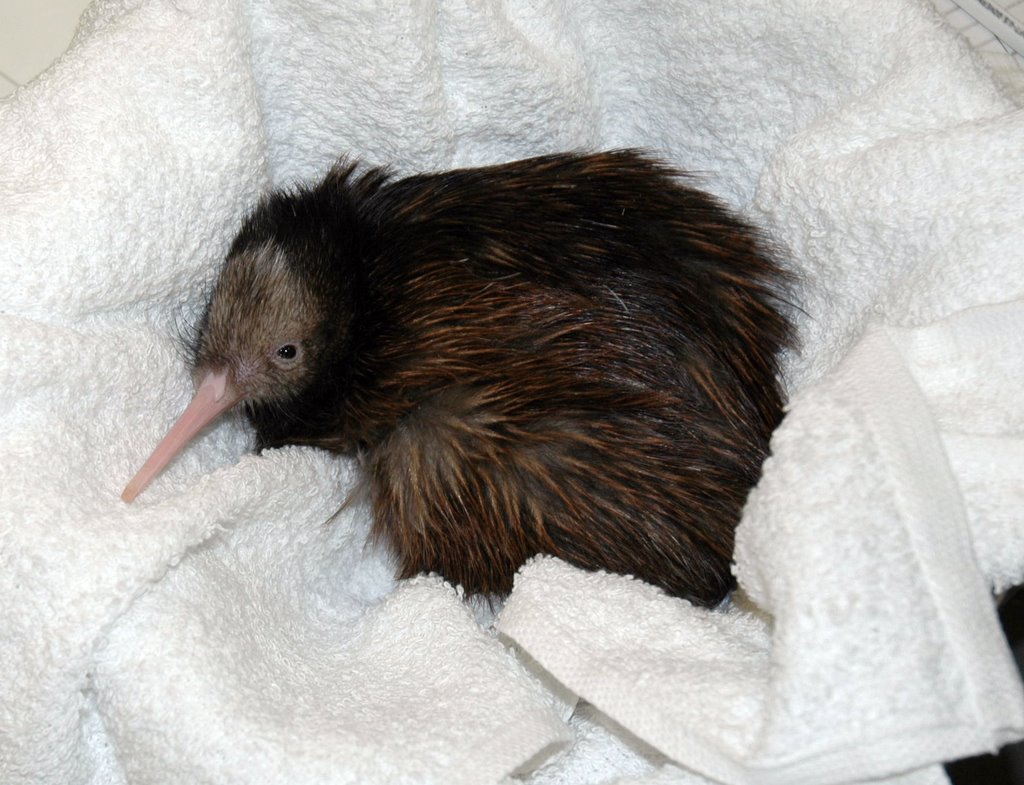
A North Island brown kiwi has hatched at the Smithsonian's National Zoo-only the second of these endangered kiwis to hatch during the Zoo's 116-year history. The National Zoo is one of just four zoos in the world to breed kiwis outside of New Zealand.

The bird hatched on Monday, Feb. 13, after 64 days of incubation. A quick health exam by National Zoo veterinarians and Bird House staff determined that the chick was healthy. In the last few weeks, National Zoo Bird House staff monitored the chick's development inside the egg each day, by weighing and candling the egg-a procedure that uses a bright light to illuminate the egg's interior, enabling staff to see the egg's air cell and monitor the chick's growth inside.

The kiwi chick weighed 9.7 ounces when it hatched and will rest in an incubator for the first week; it will be removed for daily weighing. Once it is able to stand, it will be placed in a specially designed brooder box off-exhibit, where it will continue to grow and develop under the careful observation of Zoo staff. Kiwi chicks hatch fully feathered, with their eyes open and begin foraging for small worms and berries after their first week of life, since they receive no help from their parents.

In 1975, the National Zoo was the first institution outside of New Zealand to hatch a kiwi. That 30-year-old bird is still on exhibit at the Zoo's Bird House. The Zoo currently has five kiwis―one female, three males and the newly hatched chick, whose gender is not yet known.

The five recognized species of kiwis are all flightless, nocturnal, burrowing birds that are unique to New Zealand. North Island Brown Kiwis are listed as "endangered" by the International Union of Conservation of Nature and Natural Resources.

* National Zoo Website